
Upcoming Events
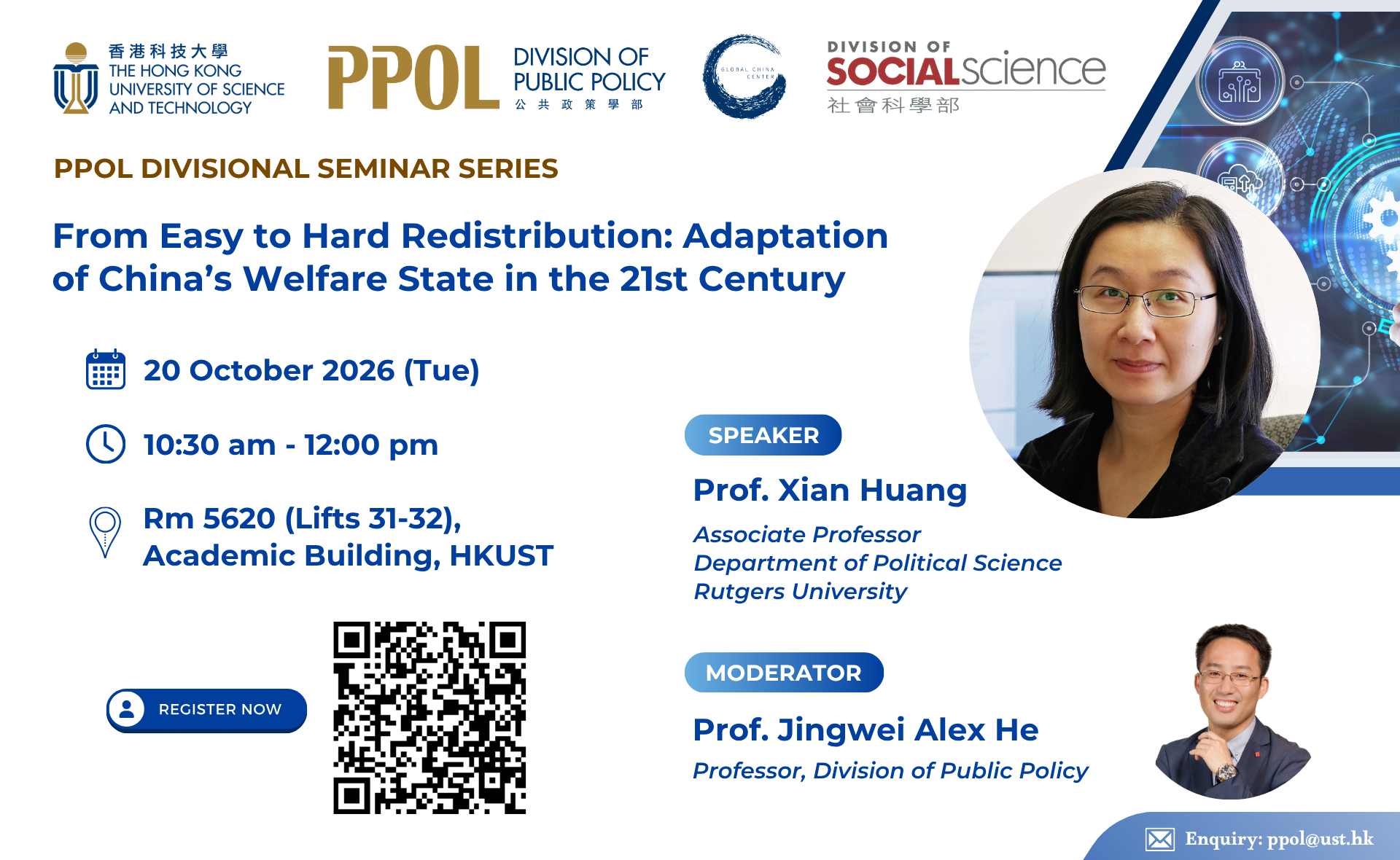
From Easy to Hard Redistribution: Adaptation of China’s Welfare State in the 21st Century
Room 5620 (Lifts 31-32), Academic Building, HKUST
Existing research explains why non-electoral regimes expand welfare provision, yet pays less attention to how the welfare systems adapt when expansion becomes difficult due to structural constraints. This paper argues that China’s welfare state has transitioned from “easy” to “hard” redistribution—a reconfiguration of welfare provision characterized by a decline in group-targeted expansion, a rise of selective cross-group integration, and a persistent dominance of vertical fiscal allocation across regions. Drawing on a corpus of 33,205 policy documents, we employ quantitative text analysis to trace patterns in Chinese welfare policy from 2000 to 2024. We find that since 2014, the government has increasingly emphasized integrating welfare programs across selected groups to facilitate risk pooling and cost sharing, while continuing to prioritize vertical allocation of responsibilities and resources between upper- and lower-level governments over horizontal coordination. These findings demonstrate the adaptation of China’s welfare state on both social and territorial dimensions under tightening fiscal and demographic constraints. READ MORE...
Past Events
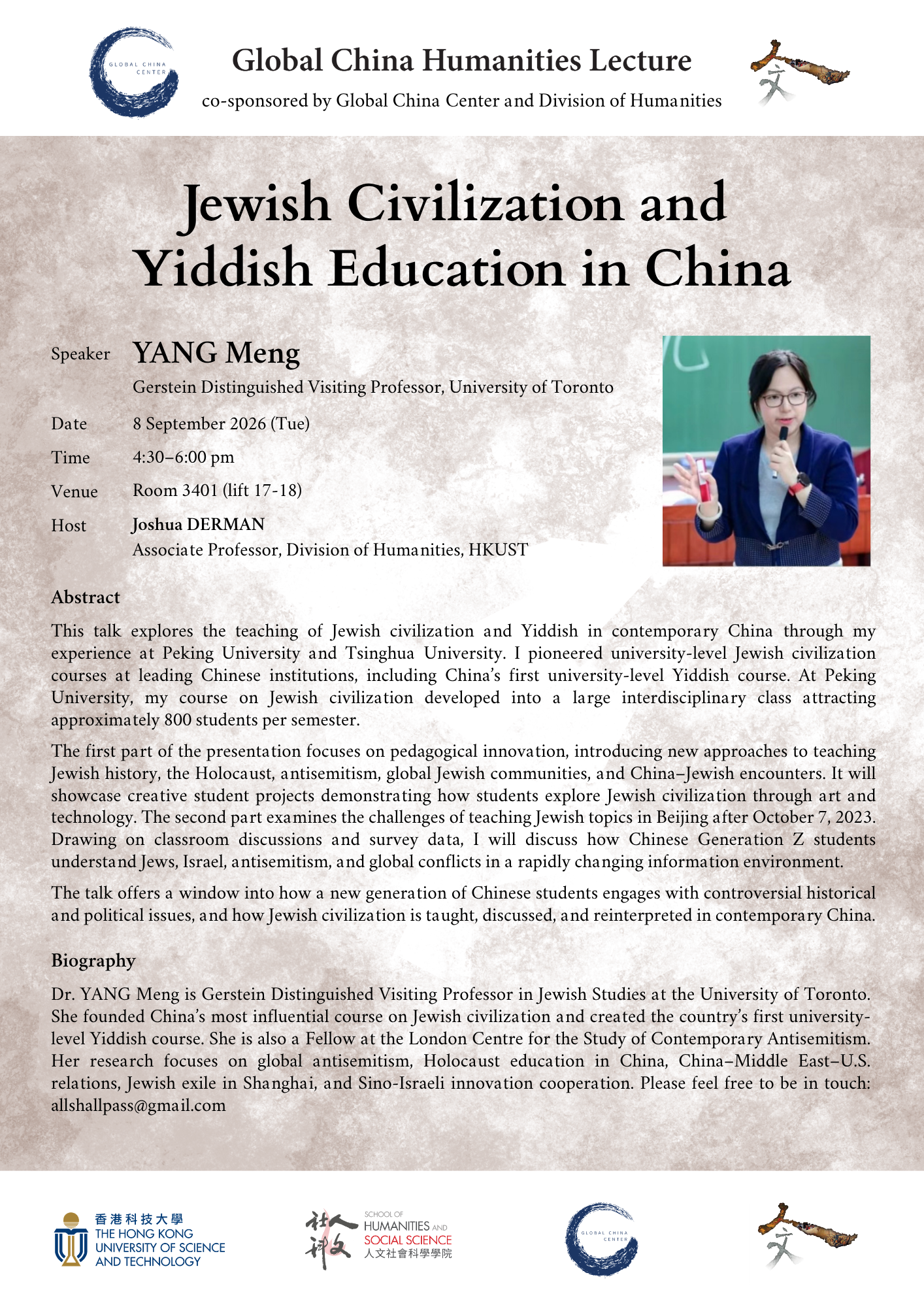
Jewish Civilization and Yiddish Education in China
Room 3401 (Lift 17-18), HKUST
This talk explores the teaching of Jewish civilization and Yiddish in contemporary China through my experience at Peking University and Tsinghua University. I pioneered university-level Jewish civilization courses at leading Chinese institutions, including China’s first university-level Yiddish course. At Peking University, my course on Jewish civilization developed into a large interdisciplinary class attracting approximately 800 students per semester. READ MORE...